
Mirror, Mystery and The Language of Memory
Ruminations from rewatching Eve's Bayou

This piece began in a more academic space — but it’s stayed with me far beyond the assignment. Eve’s Bayou explores the kind of memory work and myth-making that feels right at home here, in this newsletter.

Through the eyes of a child and the voice of an adult, Eve’s Bayou unravels memory as both a mirror and a mystery, where truth is unstable and perspective is all that matters. In her debut as a writer and director, Kasi Lemmons constructs a narrative that blurs the boundaries between past and present, revealing how trauma distorts memory and storytelling becomes a way of negotiating truth—ultimately suggesting that not everything can be fully understood, even when witnessed with your own eyes.
Eve’s Bayou opens with the voice of an adult Eve Batiste reflecting on the summer her father died—a voice, her voice, is seemingly calm, lyrical yet tinged with grief and uncertainty. “Memory is a selection of images,” she tells us, “some elusive, others printed indelibly on the brain.” From the very first line, director Kasi Lemmons establishes memory not as fact, but as something fluid, something also shaped by body reactions. The feeling of a remembered past rather than a documented one. The film’s warm, saturated color palette, soft lighting, and slow camera movements set a tone that is dreamlike. It carries an intimacy that lets us know what we are about to witness is both personal and familial. This opening sequence—narrated by a voice that already admits it may not be reliable—immediately signals to the viewer that Eve’s Bayou will explore the truth and its instability, all through a child’s eyes.
Lemmons immerses the viewer in Eve’s perspective through the use of low-angle framing that matches her physical eye level. Many key scenes are shot at a height that mimics Eve’s point of view. This reinforces the idea that we’re seeing events not as they objectively happened, but as Eve remembers them. An early example of this in the film is during the party scene at the top, the camera often lingers at Eve’s level as she weaves through a sea of adults. We see her father, Louis, flirting with another woman not in a dramatic close-up, but from across the room—partially obscured, glimpsed through gaps between grown-up bodies. This limited vantage point builds the sense that Eve is always watching but doesn’t yet fully understand what she’s seeing. Similarly, in the scene where she spies on her father and Matty Mereaux in the carriage house, the camera doesn’t intrude on the adults—it stays behind Eve, mimicking her hidden view, making the moment feel secretive and uncertain. These choices in framing reflect how children absorb the world: not through clarity, but through fragments, overheard conversations, and fleeting glances. This continues to build the emotional logic of memory over literal truth.
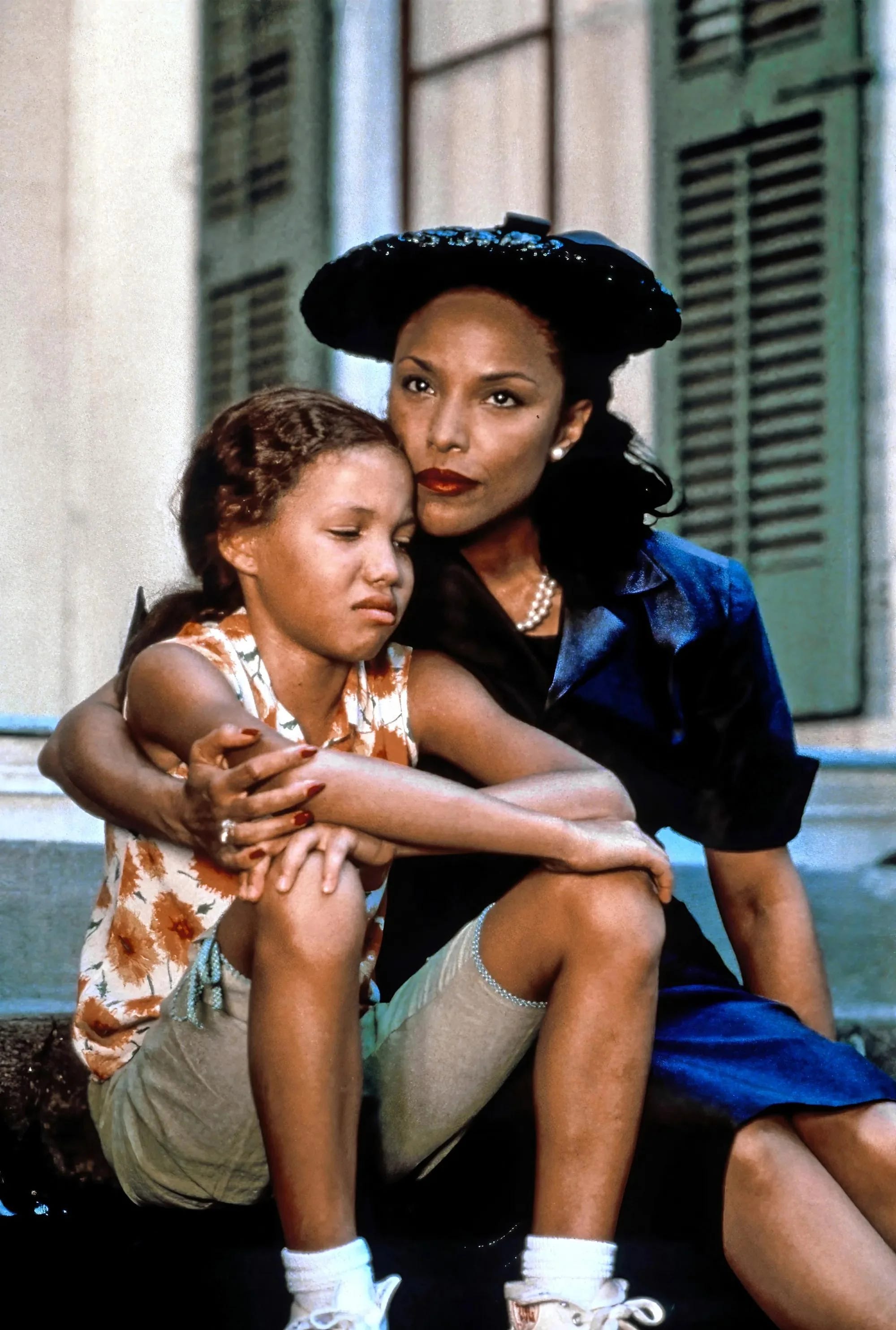
The emotional and narrative ambiguity of Eve’s Bayou is made possible by its Southern Gothic framework; a genre that thrives on haunting contradictions, buried family secrets, and the weight of the past. The southern gothic genre’s lineage offers Kasi Lemmons liberties like stretching narrative conventions, allowing meaning to emerge in silence and shadows. There’s an expansiveness in the genre’s structure that permits a story like this to unfold— unravel, without certainty.
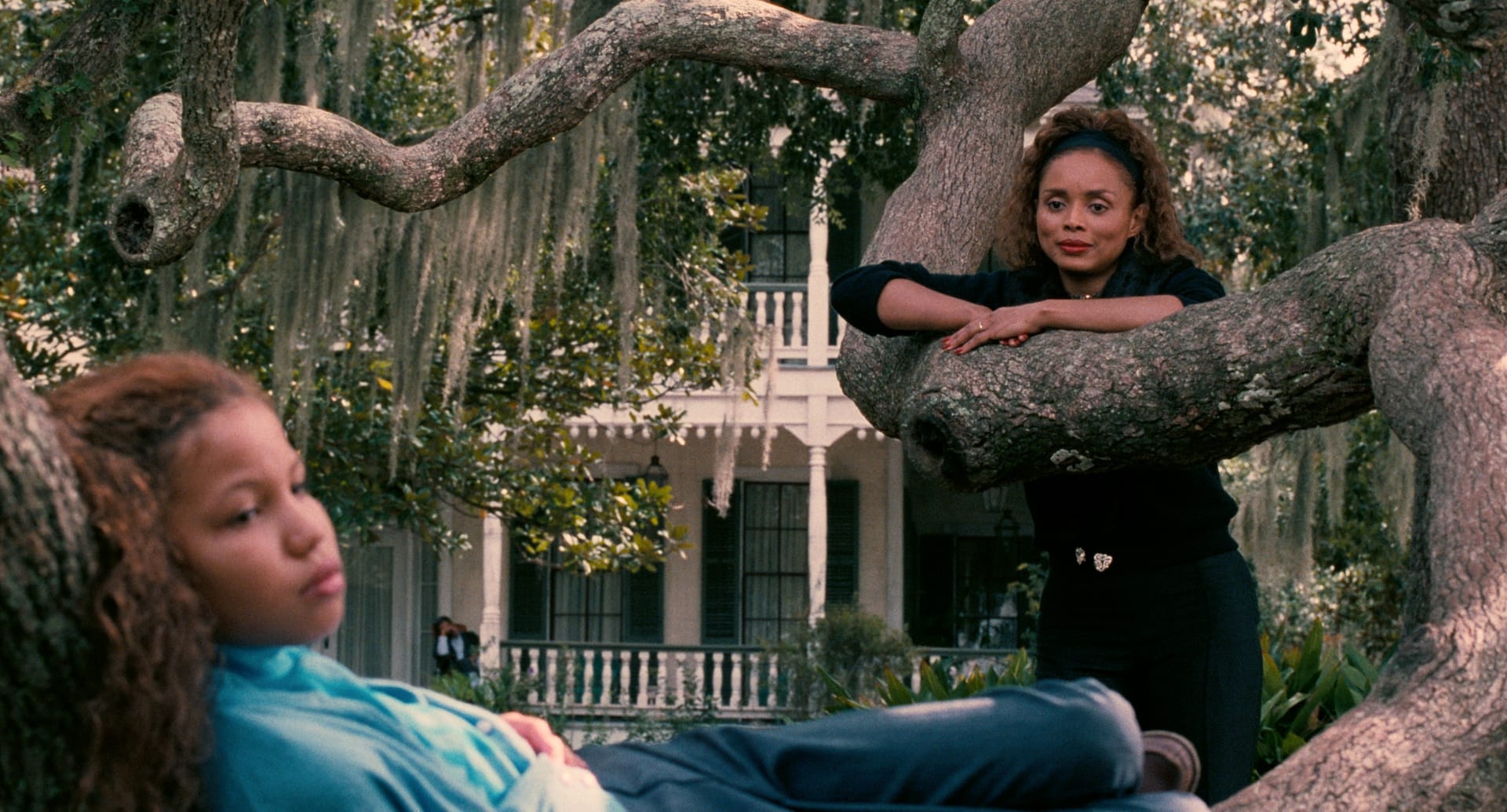
Working in collaboration with cinematographer Amy Vincent, Lemmons conjures images that are unmistakably Gothic, crafting a visual language that mirrors the psychological unraveling of the Batiste family. The sprawling, decaying mansion becomes more than setting—it’s a symbol of (potentially fading) Southern wealth and pride, a once-glorious estate growing old. Surrounded by swamp and tangled moss, the estate becomes a landscape of ghosts, both literal and emotional, where shadows loom and secrets grow thick.
And what is a Gothic tale without its haunted women—isolated, grief-ridden, and teetering on the edge of madness? Roz, Eve’s mother, moves through the house with the quiet ache of betrayal, her pain obvious to everyone and yet never spoken aloud—an archetypal Southern silence. Mozelle, whose string of dead husbands and supernatural visions keep the mystical threads of the genre alive, offers prophecy and intuition in a world where logic has failed. Cisely, isolated and withholding, carries her own secret wound and learns to distort truth through storytelling. And then there is Eve herself—absorbing everything like a sponge, inheriting the weight of this lineage, forming memory as myth. Through her eyes, all of it—beauty, sorrow, decay. The Southern Gothic doesn’t just enhance this story; it enables it. It provides a space where trauma can live in metaphor, where memory can speak through atmosphere, and where truth remains elusive but never irrelevant. The film hums with a slow-burning tension, asking the audience not for clarity, but for our attention.
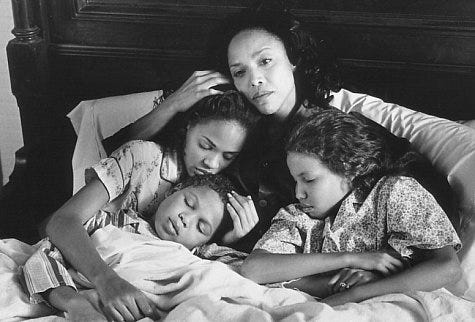
Midway through the film, Lemmons offers a dramatic shift in perspective through Mozelle, Eve’s aunt and a mystic who carries her own burden of loss and longing. In one of the most visually and emotionally charged scenes, Mozelle sits with Eve, having just scolded her for lashing out and spilling hard truths to Roz, stoically played by Lynn Whitfield.
“And where’s Daddy? He’s never home!” Eve screams. “He ought to be home sometime.” Roz stands motionless, stunned by what her daughter knows—and what she herself tries to forget. Mozelle pulls Eve away, threatening her life and demanding she show more grace for her mother.
As they settle into the stillness of the moment, the camera lingers on the two. Mozelle reflects on her own past, on the men she’s loved and lost, and the life she’s lived without children to “catch her” in moments of sin or passion. With the help of a mirror, Mozelle falls into a memory that begins to take shape in the Batiste living room. She watches her former husband and lover fight over her, just as they did years ago in her own home. Our vantage shifts to that of Mozelle. Through her gaze and the use of the mirror, we are transported into this memory while never actually leaving the Batiste house—let alone the frame. And when it comes time for Mozelle to enter the memory herself, she steps into the reflection, leaving Eve to watch a retelling of something she never actually witnessed. But with this vantage, with 1re-memory, she—and we—are given a front row seat. Lemmons tilts the mirror, allowing the story to be refracted through Mozelle’s memory. We see how grief, love, and regret have shaped her worldview. When she begins to recount a past affair, Lemmons doesn't just tell us the memory—she folds Eve into it. The effect is haunting. It blurs the line between memory and imagination, between the storyteller and the listener. Through this surreal shift, Lemmons deepens the film’s central claim: memory is not stable, and stories change depending on who is telling them. Mozelle’s recollection becomes Eve’s lesson, a generational transmission of sorrow. When the perspective shifts back to Eve, it returns altered—now layered with the weight of inherited memory and the realization that the truth is always a matter of what you remember, and how it haunts you.
Lemmons’ choice to structure Eve’s Bayou as a memory piece—told through the retrospective voice of adult Eve—infuses the narrative with both emotional complexity and thematic ambiguity. By withholding the full truth of Cisely’s experience until the end, the film challenges the viewer to wrestle with memory’s slipperiness and the limitations of knowing. The placement of key scenes, particularly Eve’s witnessing of her father's death, reframes our understanding of earlier moments and forces us to negotiate our emotional allegiances. Are we rooting for Eve or against her father? Are we clapping for justice or complicit in tragedy? These tensions come to a head in Mozelle’s final monologue, delivered after the funeral, as the bayou resets. Her dream of flying while watching a version of herself drown captures the duality of survival—what must be sacrificed in order to keep living, what must be forgotten to move on. This poetic moment, like the film’s form, refuses clear answers. It underscores how memory, grief, and truth tangle together, shaping not just what we remember, but who we become. The narrative’s nonlinear structure isn’t just a stylistic choice—it’s an emotional architecture that allows Eve, and us, to live in the liminal spaces between guilt and grace, betrayal and forgiveness.
Toni Morrison’s concept of re-memory, introduced in Beloved, describes the way memories—especially traumatic ones—live beyond time, returning through physical spaces, storytelling, and the body itself. “Re-memory” isn’t just recollection; it’s a haunting, an active return